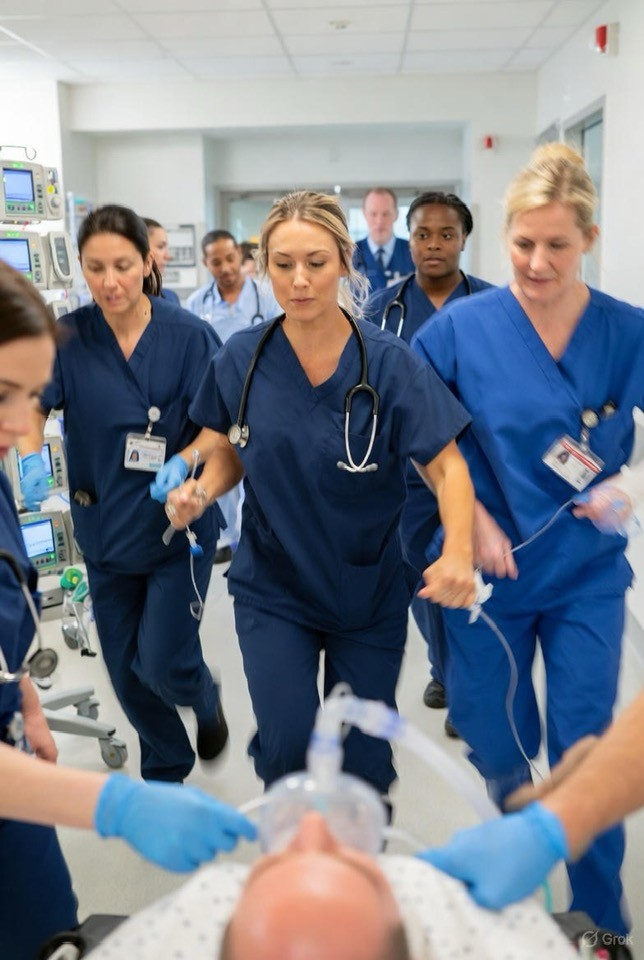
Nurses play a crucial role in the healthcare industry. Without their time, skills, and dedication, healthcare would not exist in its current form. Registered nurses (RN) earn a Bachelor’s degree, pass national licensure tests, keep up with clinical skills, and act as the key decision maker at the bedside. However, nurses’ wages do not compare to many professions—now even non-professional ones, despite what is required of the nursing field. Inequity in nursing’s compensation is an epidemic that has been unjustly prevalent and hazardous to patients, staff retention, and the future of the profession.
Working Conditions: Professional Expectations and Low Pay for RNs Essay
Preparation
Nurses must complete a BSN or Associate’s degree program before sitting for the NCLEX-RN licensure exam and are subsequently responsible for a wide variety of professional tasks, including administering medication, care coordination, documentation, and the rapid identification and treatment of life-threatening conditions. While it is assumed that professionals are compensated with appropriate wages for their service and skill, research indicates this is not true for nursing.
Workforce analytics have shown that registered nurses’ median salary is frequently lower than the salaries of professions that require similar, if not less, education in the areas of technology, engineering, finance, and data science (Buerhaus et al., 2017). These professions often feature clear salary progression, remote work availability, and more predictable hours in comparison to traditional frontline nursing. These patterns point to a systemic devaluation of nursing as a profession and a commitment to traditional gender norms that treat nursing as a natural extension of the unpaid care work expected of women.
The Rise of Non-Professional Jobs Outpacing Nurse Wages
More disturbing still is the sharp increase in the number of jobs that pay as much as nurses or more without being professional roles. Warehouse logisticians, drivers, manufacturing laborers, hospitality managers, couriers, and delivery personnel are a few of the many job categories that have rapidly increased wages to compete for labor or to take advantage of economic shifts. Many of these jobs need minimal training, no educational background, and pose no clinical risk to the employee. In some areas, the pay for these jobs now exceeds that of the RN (Fraher et al., 2020).
Nurses, on the other hand, are expected to handle extreme emotional labor, physical hardship, and life-and-death clinical decision-making. They triage and stabilize deteriorating patients, deliver trauma-informed care, and provide their expertise to chronically understaffed units with rising patient acuity. The reality that a job description requiring no degree or licensure can offer pay that is equivalent to or greater than an RN’s salary speaks to a system of labor that has no regard for work that saves lives.
Burnout, Turnover, and Workforce Instability Essay
Underpaying nurses has serious ramifications. The nursing workforce is at an all-time high in terms of burnout, emotional fatigue, and turnover. Evidence has been found that shows a direct relationship between low pay, staffing shortages, and poor patient outcomes (Shah et al., 2021). Nurses that burn out are at a greater risk of leaving their positions or the profession altogether, which only further increases shortages. Staffing shortages lead to increased patient-to-nurse ratios, which have demonstrated higher rates of medication errors, missed care, mortality, and lower patient satisfaction.
According to Drennan and Ross (2019), nurse shortages worldwide have an obvious, immediate impact on the ability to access and provide quality care. Paying nurses substandard wages not only deny them the respect they deserve but also creates a vicious cycle of instability that harms entire healthcare systems. Competitive pay is key in retaining nurses and staffing at optimal levels to protect patients.
Raising nurses’ pay is a public health intervention.
Higher wages will help with retention, burnout, and patient safety. Hospitals with proper staffing and living wages have lower turnover, better team morale, and better clinical outcomes.
Fair compensation acknowledges the high-level thinking, specialized knowledge, and emotional labor that nurses perform. Additionally, it represents a long-overdue correction to a decades-old system of systemic inequities. Healthcare cannot afford to lag behind when every other industry has made adjustments, progressed, and increased compensation. Patient care in the future depends on a stable, respected, and fairly paid nursing workforce.
Conclusion
Nurses are professionals. Nurses are not angels. They are highly educated clinical experts who save lives every day. We are underpaid compared to other professions with similar or lesser education. We are underpaid compared to professions that save lives. We are underpaid compared to professions that are dangerous. We are underpaid compared to professions that place themselves at risk to benefit those less fortunate. Underpaying nurses causes burnout, turnover, and staffing shortages. These problems directly affect the quality of care we can provide for our patients. The only way we as a society can truly value nurses as the professionals that we are is through not just a round of applause but through tangible respect that translates to a living wage and better working conditions.
It’s time we start paying nurses what they are worth.
References
Buerhaus, P. I., Skinner, L., Auerbach, D. I., & Staiger, D. O. (2017). Four challenges facing the nursing workforce in the United States. Journal of Nursing Regulation, 8(2), 40–46.
Drennan, V. M., & Ross, F. (2019). Global nurse shortages—the facts, the impact and action for change. British Medical Bulletin, 130(1), 25–37. https://doi.org/10.1093/bmb/ldz014
Fraher, E., Pittman, P., Frogner, B., Spetz, J., Moore, J., & Beck, A. (2020). Ensuring and sustaining a pandemic workforce. Health Affairs, 39(9), 1603–1607. https://doi.org/10.1377/hlthaff.2020.00903
Shah, M. K., Gandrakota, N., Cimiotti, J. P., Ghose, N., Moore, M., & Ali, M. K. (2021). Prevalence of and factors associated with nurse burnout in the U.S. JAMA Network Open, 4(2), e2036469. https://doi.org/10.1001/jamanetworkopen.2020.36469
Written By:
Juram Gorriceta MPA, BSN-RN LHSSP
Nurse Educator, Advance Simulations specialist.
 Healthcarebeyond
Leave a comment