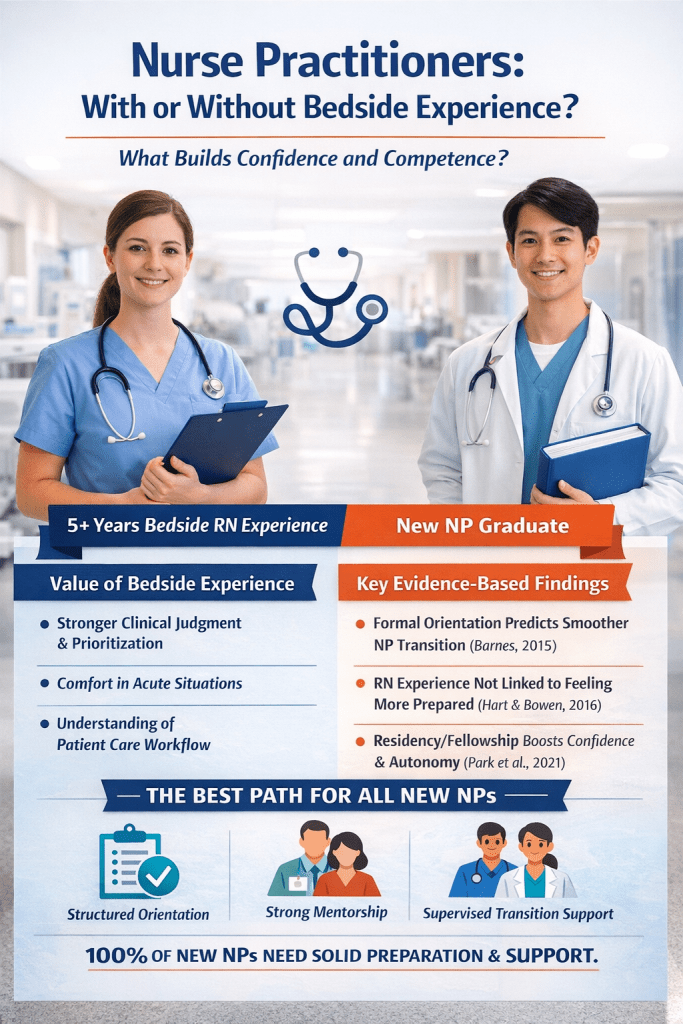
As a nurse educator and someone who values evidence-based practice, I believe this conversation deserves honesty, balance, and a strong focus on patient safety. The question is not simply whether a nurse practitioner has bedside experience or not. The real question is this: what truly prepares an NP to practice safely, confidently, and competently?
Many nurses feel strongly that bedside experience matters, and I understand why. Working on the floor teaches skills that are hard to replace. It builds clinical judgment, prioritization, communication, time management, and the ability to recognize subtle patient changes. Nurses who spend years at the bedside often develop a practical sense of what can go wrong, what needs immediate attention, and how to work within the realities of patient care.
At the same time, I do not believe that bedside experience alone should be treated as the only marker of readiness. Evidence shows that while prior RN experience is valuable, it does not automatically predict a smoother transition into the NP role. What matters greatly is whether the new NP receives strong orientation, mentorship, quality A preceptorship is a period of practical experience and training under the guidance of an experienced mentor or supervisor., and structured support during the transition to advanced practice.
This is where I believe the profession needs to be more honest. We sometimes argue too much about who has “enough” experience and not enough about whether we are truly preparing and supporting new nurse practitioners. A new NP with years of bedside experience may still struggle if orientation is weak. On the other hand, a new NP without extensive floor experience may still grow into a strong clinician if the education is solid and the transition-to-practice support is strong.
My view is clear: bedside experience should be strongly encouraged, especially in acute care and specialty settings, but no new NP should be left to transition alone. If we care about competence, confidence, and patient safety, then every new NP should have access to structured orientation, mentorship, and supervised transition support. That should be the standard, not the exception.
This is not about safekeeping. It is not about discouraging growth or ambition. It is about protecting patients and strengthening the profession. Confidence should never come from title alone. It should come from preparation, humility, support, and experience gained over time.
In the end, what truly builds a competent NP is not one single factor. It is the combination of education, clinical exposure, mentorship, and a safe transition into practice. Bedside experience is valuable. Formal preparation is essential. Support is critical. And when all of these come together, both patients and providers benefit.
My suggestion
I believe 100% of new NPs should receive structured orientation, mentorship, and supervised transition-to-practice support, whether they come into the role with years of bedside experience or not. For higher-acuity roles, bedside experience should be strongly preferred. For every role, patient safety must come first.
References:
Barnes, H. (2015). Exploring the factors that influence nurse practitioner role transition. The Journal for Nurse Practitioners, 11(2), 178–183.
Hart, A. M., & Bowen, A. (2016). New nurse practitioners’ perceptions of preparedness for and transition into practice. The Journal for Nurse Practitioners, 12(8), 545–552.
Park, J., Covelli, A. F., & Pittman, P. (2021). Effects of completing a postgraduate residency or fellowship program on primary care nurse practitioners’ transition to practice. Journal of the American Association of Nurse Practitioners.
Written by:
Juram Gorriceta, MPA, BSN, RN, LSSHP
Nurse Educator | DNP Candidate | Evidence-Based Practice Advocate
 Healthcarebeyond
Leave a comment